
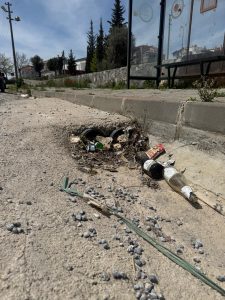
During wet-weather events, litter accumulated along streets, gutters, and other urban surfaces can be mobilized by runoff and transported through communities. Along its pathway, litter may remain on the surface, become captured by or block storm-drain inlets, enter the drainage network, or reach rivers and coastal waters. Although plastic transport has been widely studied in oceans and rivers, the processes controlling its movement from inland sources to receiving waters remain poorly understood. Quantifying these land-based pathways is essential for estimating litter supply to aquatic environments and identifying effective intervention locations.The primary goal of this project is to develop a physics-based modeling framework for simulating inland litter hydrodynamics during rainfall and flooding events. The framework couples hydrologic and hydraulic models with the Force-based Lagrangian Object Transport (FLOTR) model. Hydrologic and hydraulic simulations provide spatially and temporally varying runoff depth and velocity, while FLOTR determines litter mobilization, transport velocity, and movement pathways based on flow conditions, surface characteristics, and object properties. The framework also represents interactions with stormwater infrastructure, including inlet capture, blockage, and continued surface transport. For coastal communities, it can evaluate how rainfall–tide interactions alter litter mobility and retention. Ultimately, this tool helps quantify where and when litter moves, where it accumulates, and how much may reach rivers or the ocean.This project is sponsored by Prevented Ocean Plastic™. Prevented Ocean Plastic™ is high-quality, certified recycled plastic collected from coastal areas at risk of ocean plastic pollution. Used by supermarkets and brands worldwide, it meets regulatory health and safety standards, is traceable to its source, and can be identified by its distinctive triangular blue logo.
Project Team
Dr. Felix Santiago-Collazo, Dr. Jenna Jambeck, Naz Oruc Baci
Sponsor
