
Legacy contaminants can remain stored in riverbanks and floodplains long after their original release. During extreme rainfall, increased flow depths and velocities may erode these deposits. However, erosion does not necessarily result in downstream export because mobilized sediment may remain locally stored or redeposit within the floodplain. Understanding this distinction is important for evaluating contaminant-transport risks.
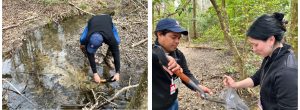
CITRA developed a high-resolution coupled modeling framework for Tims Branch at the U.S. Department of Energy’s Savannah River Site, where uranium is associated with sediment stored within the stream corridor. GSSHA simulates rainfall-runoff from the upper watershed to Beaver Pond #1, while a two-dimensional HEC-RAS model routes water through the downstream reach and evaluates flood depths, velocities, sediment-transport capacity, erosion, and deposition. Field-collected sediment samples characterized the predominantly sand-bed system, and the models were evaluated using available site observations.
Results indicate that Beaver Pond #1 substantially reduces the downstream response during smaller events. For 24-hour storms with return periods of 50 years or less, transport-capable conditions remain largely confined to the main channel. Larger events create more connected sediment-transport pathways and produce more extensive, but generally localized, erosion and redistribution along the channel margins and floodplain. The simulations also suggest that much of the mobilized material has limited potential to re-enter the main channel and travel farther downstream. This phase modeled sediment rather than uranium directly and provides the hydrologic and hydraulic foundation for future contaminant fate-and-transport analysis.
Project Team
Dr. Felix Santiago-Collazo, Naz Oruc Baci, and Orlando Viloria Marimon
Sponsor